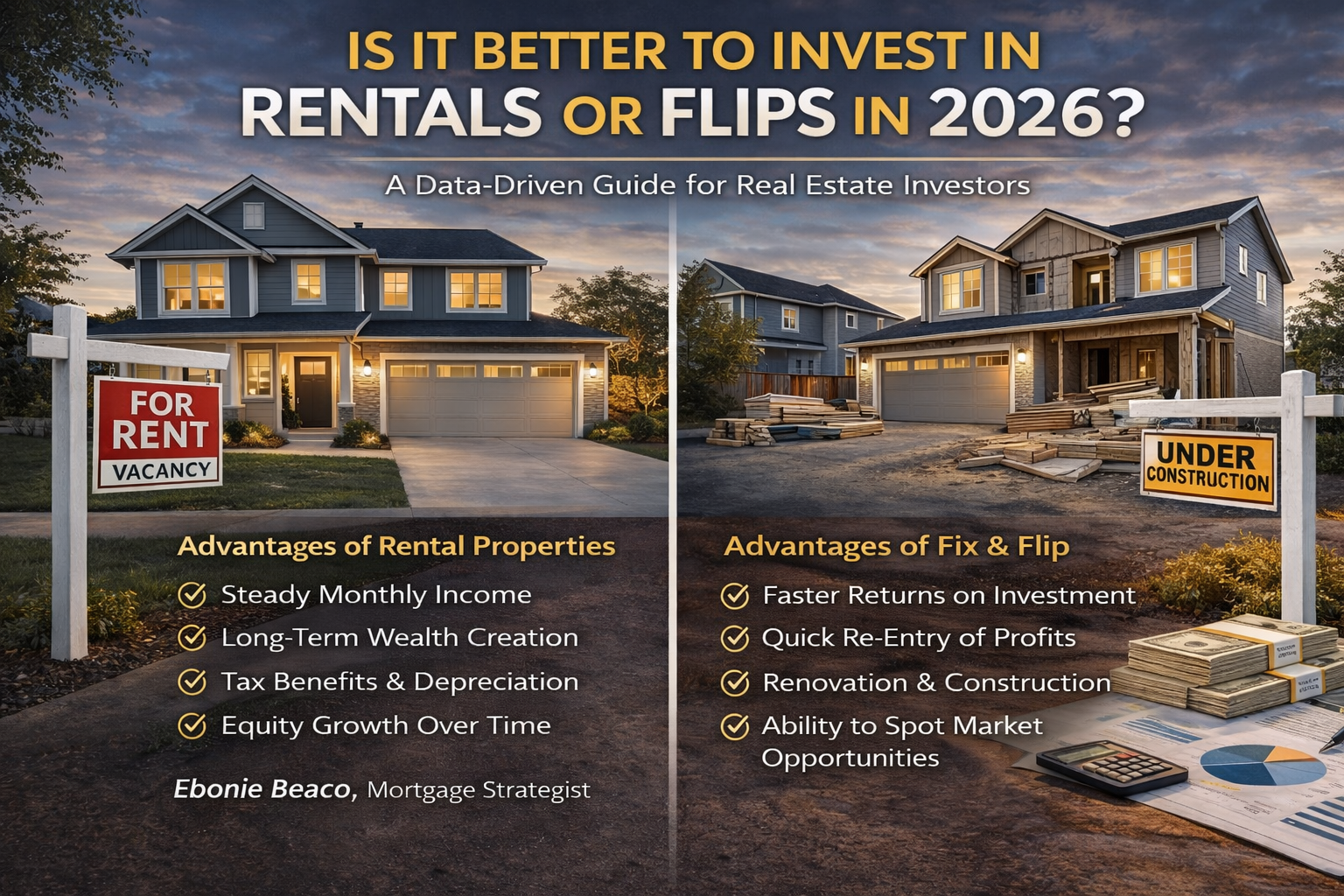
Real estate investors entering the market in 2026 are asking an important strategic question: Is it better to invest in rental properties or focus on house flipping? Both strategies have created significant wealth for investors over the past two decades, but the current housing market environment has shifted the risk profile and profit potential of each approach. Rising property values, higher renovation costs, and fluctuating mortgage rates have changed how investors evaluate deals. At the same time, strong rental demand and limited housing supply have created new opportunities for investors who want to build long term cash flow. Understanding the differences between rental investing and flipping is essential for making informed investment decisions in 2026. The right strategy often depends on your financial goals, risk tolerance, and access to financing.
As a Mortgage Strategist, Ebonie Beaco, I often explain to investors that the real question is not which strategy is universally better. Instead, the key is determining which strategy aligns with your long term financial goals and your financing structure.

Understanding the Two Strategies: Rentals vs Fix and Flip
Rental property investing and house flipping are two of the most popular real estate investment strategies. While both involve purchasing property with the goal of generating profit, they operate on completely different timelines and financial models. Rental investing focuses on long term wealth building through income producing properties, while flipping is centered on short term profits through renovation and resale.
Rental property investing typically involves purchasing a property, placing tenants, and holding the asset for many years while generating monthly income and equity growth. Flipping, on the other hand, involves purchasing distressed properties, renovating them, and reselling them quickly for a profit. Investors who flip houses usually aim to complete projects within several months to maximize returns.
Key differences between the strategies include:
• Rental investing focuses on long term cash flow and appreciation
• Flipping focuses on short term profit from property resale
• Rental properties create recurring income
• Flips generate one time profits per transaction
Understanding these structural differences is critical when evaluating which approach may perform better in the current market cycle.
The Current Fix and Flip Market in 2026
House flipping became extremely popular during the housing boom of the 2010s and early 2020s. Investors were able to purchase distressed properties, renovate them quickly, and resell them into a rapidly rising market. However, the economics of flipping have changed significantly over the past several years. Rising home prices have increased acquisition costs for investors, while higher renovation costs have reduced profit margins.
According to data from ATTOM Data Solutions, the typical flipped home in 2025 generated about $60,000 in gross profit with a 23.1 percent return on investment, the lowest profit margin since 2008.
These declining profit margins reflect several structural changes in the market. Home prices have increased significantly in many regions, making it harder for investors to purchase properties at a deep discount. At the same time, construction labor shortages and higher material costs have increased renovation budgets.
Challenges facing house flippers in the current market include:
• higher acquisition prices for investment properties
• rising renovation and construction costs
• longer resale timelines due to higher mortgage rates
• increased competition from other investors
While flipping can still produce strong profits in the right markets, it has become more dependent on precise deal analysis and local market conditions.
The Strength of Rental Property Investing in 2026
While flipping margins have tightened, the rental housing market continues to show strong long term demand. Millions of Americans are currently renting homes due to affordability challenges and lifestyle preferences. The United States has experienced significant population growth and household formation over the past decade, which has increased the need for rental housing across many regions.
Rental properties provide investors with several powerful wealth building advantages. Unlike flipping, which produces a single transaction profit, rental properties generate ongoing income while also benefiting from long term appreciation.
Advantages of rental property investing include:
• monthly rental income and cash flow
• long term property appreciation
• tax benefits such as depreciation deductions
• equity growth as the mortgage balance is paid down
• the ability to refinance and leverage equity to acquire additional properties
Rental demand remains strong across many metropolitan markets. For example, several major cities have experienced rent growth of around 4 percent year over year, demonstrating continued demand for rental housing.
This ongoing demand creates a stable income stream for investors who hold rental properties long term.
Investor Activity in the Housing Market
Investor participation in the housing market remains significant in 2026. Recent housing data shows that investors accounted for nearly 27 percent of home purchases during early 2025, demonstrating the continued interest in real estate as an asset class.
This surge in investor activity highlights the growing recognition that real estate remains one of the most powerful wealth building tools available. Investors are drawn to real estate because it provides a combination of income generation, appreciation potential, and tax advantages.
Some investors pursue a hybrid strategy by flipping properties to generate short term capital and then reinvesting those profits into rental properties. Others focus exclusively on building long term rental portfolios that produce recurring income.
Comparing Returns: Rentals vs Flips
When evaluating the profitability of rentals versus flips, it is important to understand that the financial outcomes differ significantly depending on time horizon. Flipping may produce faster profits, but rental investing often produces larger wealth accumulation over time due to appreciation and leverage.
Typical flipping returns in recent years have ranged between 20 percent and 30 percent gross return on investment before expenses, depending on market conditions.
Rental properties, however, create multiple streams of financial benefit over time.
These include:
• monthly rental income
• property appreciation
• equity growth through loan amortization
• potential tax advantages
For example, a rental property that produces $500 in monthly cash flow can generate $6,000 in annual income. Over a ten year period, that same property may also appreciate significantly in value while the mortgage balance is reduced by tenant payments.
This combination of income and appreciation is why many investors prefer long term buy and hold strategies.
When Flipping May Be the Better Strategy
Despite the challenges facing the fix and flip market, flipping can still be extremely profitable in the right situations. Investors who have strong construction knowledge, access to contractor networks, and the ability to identify undervalued properties may still achieve significant profits.
Flipping may be more suitable for investors who:
• want faster returns on invested capital
• have renovation experience or construction expertise
• can find properties significantly below market value
• have access to short term renovation financing
In markets with older housing stock and strong buyer demand, flipping can still generate attractive returns.
When Rental Properties May Be the Better Strategy
For many investors in 2026, rental properties are becoming the preferred investment strategy. Long term property ownership provides financial stability and allows investors to benefit from market appreciation over time.
Rental investing may be ideal for individuals who want to:
• build long term wealth through real estate
• create passive or semi passive income
• leverage financing to acquire multiple properties
• hold assets that appreciate over time
Many experienced investors eventually transition toward rental portfolios because they provide consistent income and long term asset growth.
The Financing Strategy That Makes Both Work
Regardless of whether an investor chooses rentals or flips, financing plays a critical role in determining profitability. Access to the right loan programs can dramatically improve an investor’s ability to acquire and scale real estate assets.
Common financing options for real estate investors include:
• DSCR investor loans based on rental income
• bridge loans for renovation projects
• fix and flip financing
• cash out refinance strategies for portfolio expansion
Final Thoughts: Rentals vs Flips in 2026
So which strategy is better in 2026: rental investing or house flipping?
The answer depends on your financial goals and investment strategy. Flipping can generate faster profits when deals are structured correctly, but it requires precise execution and strong market timing. Rental properties may generate slower returns initially, but they provide long term cash flow, appreciation, and equity growth that can compound over decades.
In today’s housing market, many investors are choosing a balanced strategy that combines both approaches. Some investors flip properties to generate capital and then reinvest those profits into rental properties that produce long term income.
Real estate remains one of the most powerful wealth building tools available, especially when paired with the right financing strategy.
Apply for Real Estate Investor Financing
If you are planning to invest in rental properties, fix and flip homes, or expand your real estate portfolio, securing the right financing strategy is essential.
Apply for mortgage financing here:
https://www.homeloansnetwork.net/apply
During a complimentary consultation we can review:
• DSCR investor loans
• rental property financing
• fix and flip loan options
• cash out refinance opportunities
• portfolio expansion strategies
The right loan structure can make the difference between owning one investment property and building a scalable real estate portfolio.
Now may be the time to position yourself for the next real estate investment cycle.





Leave a Reply