For many homeowners, especially those who own high value coastal properties, their home is more than just a place to live. It is a powerful financial asset that can unlock significant borrowing potential. In premium real estate markets such as Florida beachfront communities, rising property values have created extraordinary amounts of home equity for homeowners.
According to housing market data and mortgage industry research, American homeowners collectively hold more than $34 trillion in home equity, and Florida remains one of the strongest equity growth markets in the country. Coastal properties in particular have seen dramatic price appreciation over the past decade due to strong demand, limited inventory, and the continued migration of buyers to waterfront communities.
Because of these higher property values, homeowners in luxury coastal markets can often access much larger HELOC credit lines compared with traditional residential properties. Understanding how lenders calculate HELOC borrowing limits can help Florida homeowners determine how much capital they may be able to leverage from their property.
The Basic Formula Lenders Use to Calculate HELOC Borrowing Limits
Most mortgage lenders determine HELOC borrowing limits using a calculation called the Combined Loan to Value ratio, commonly referred to as CLTV. This ratio measures the total amount of loans secured by the property compared to the property’s current market value.
In most cases, lenders allow homeowners to borrow up to 80 percent to 85 percent of the home’s total value, including the existing mortgage balance.
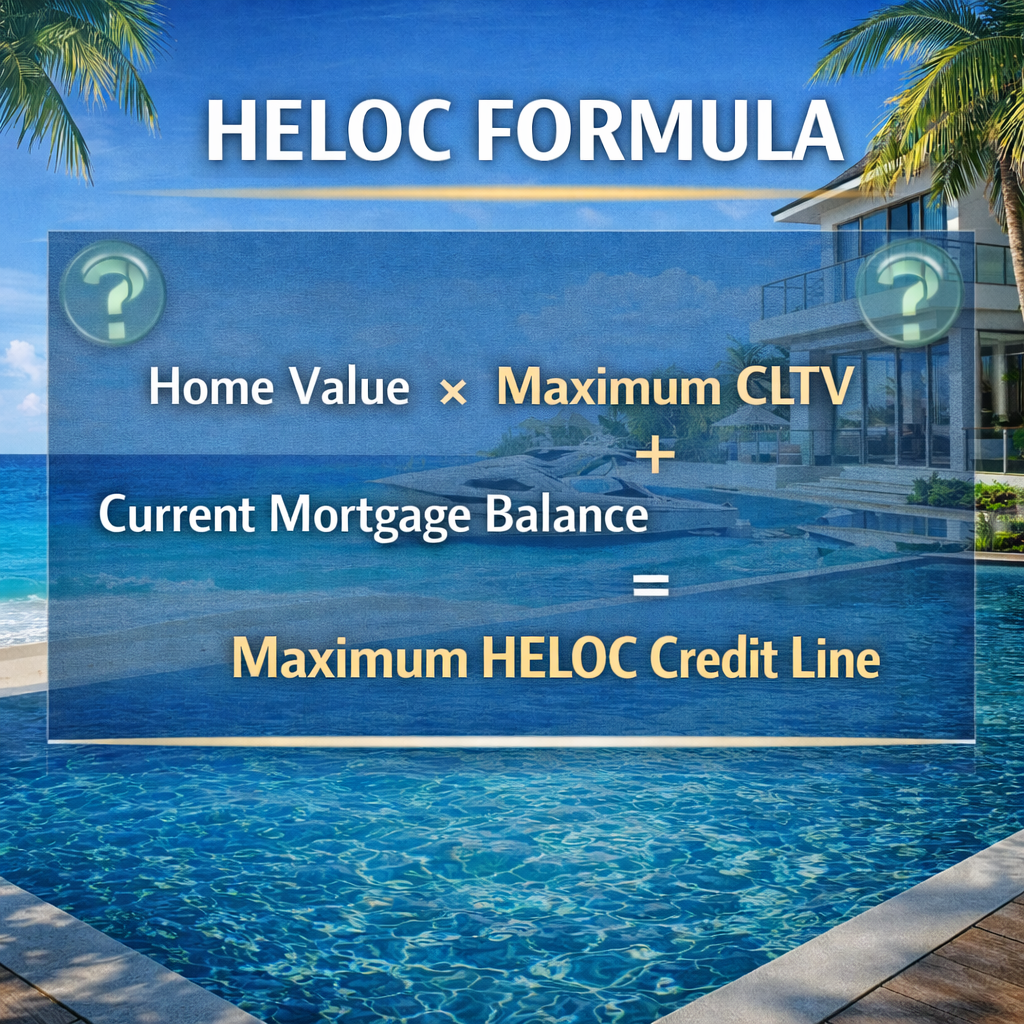
The formula used by lenders looks like this:
Maximum HELOC Credit Line = Home Value × Maximum CLTV − Current Mortgage Balance
Lenders typically require homeowners to maintain at least 15 percent to 20 percent equity in the property after borrowing, which protects both the homeowner and the lender from over leveraging the property.
For homeowners in high value markets such as beachfront communities, this formula can produce very large borrowing limits.
Florida Beachfront HELOC Example

Florida coastal real estate has experienced substantial appreciation, particularly in luxury waterfront markets. Many beachfront homes now sell for $1,500,000 to $5,000,000 or more, depending on location and property size.
Consider the following example of a Florida beachfront property.
Home Value: $2,500,000
Current Mortgage Balance: $900,000
Maximum CLTV Allowed: 85 percent
First calculate 85 percent of the home’s value.
$2,500,000 × 0.85 = $2,125,000
Next subtract the remaining mortgage balance.
$2,125,000 − $900,000 = $1,225,000
In this scenario, the homeowner could potentially qualify for a HELOC credit line of approximately $1,225,000.
This level of borrowing power is common in luxury coastal markets where property values are significantly higher than the national average.
Another High Value Florida HELOC Scenario

Now consider a luxury beachfront property in a prime coastal market.
Home Value: $3,800,000
Mortgage Balance: $1,500,000
Maximum CLTV: 85 percent
Step one:
$3,800,000 × 0.85 = $3,230,000
Step two:
$3,230,000 − $1,500,000 = $1,730,000
In this example, the homeowner could potentially qualify for a HELOC credit line of approximately $1,730,000.
Large HELOC credit lines like this are often used by real estate investors, entrepreneurs, and high net worth homeowners who want flexible access to capital while keeping ownership of their property.
Popular Florida Beachfront Cities With High HELOC Potential
Florida remains one of the most active luxury real estate markets in the United States. Several coastal cities consistently rank among the most valuable housing markets in the country, which creates significant equity opportunities for homeowners.
Two of the most popular beachfront cities include:
Miami Beach, Florida
Miami Beach is one of the most internationally recognized luxury real estate markets. Waterfront homes and luxury condos often range from $1,000,000 to well over $10,000,000 depending on location and amenities.
Strong international demand, luxury tourism, and a vibrant economy have made Miami Beach one of the most valuable coastal real estate markets in the country. Homeowners in this market often have substantial equity that can support large HELOC borrowing limits.
Naples, Florida
Naples is widely known for its luxury beachfront homes, golf communities, and high net worth residents. Many waterfront properties in Naples range between $2,000,000 and $8,000,000, with ultra luxury estates exceeding $20,000,000.
Because of these high property values, homeowners in Naples often qualify for jumbo HELOC programs that exceed $1,000,000 depending on their mortgage balance and credit profile.
Factors That Affect HELOC Borrowing Power
Although property value plays a major role in determining HELOC borrowing limits, lenders evaluate several additional financial factors before approving a credit line.
Key qualification factors include:
• Current appraised value of the property
• Remaining mortgage balance
• Credit score and credit history
• Debt to income ratio
• Income stability and employment history
• Property type and occupancy status
• Existing liens or secondary loans on the property
Borrowers with strong credit profiles and stable income typically qualify for higher credit lines and better interest rates.
Why Many Florida Homeowners Use HELOCs
HELOCs provide flexible access to capital without requiring homeowners to sell their property or refinance their existing mortgage. Because of this flexibility, many Florida homeowners use HELOCs as part of their financial strategy.
Common uses for HELOC funds include:
• Luxury home renovations and upgrades
• Investment property purchases
• Real estate development projects
• Business investments
• Debt consolidation
• Education expenses
• Emergency financial reserves
Many real estate investors also use HELOC funds to acquire additional rental properties or finance renovation projects.
Risks to Consider Before Borrowing
While HELOCs offer powerful financial flexibility, homeowners should also understand the potential risks associated with borrowing against their property.
Most HELOCs have variable interest rates, which means the interest rate may increase if market rates rise. Because the loan is secured by the property, failure to repay the loan could result in foreclosure.
Homeowners should carefully evaluate their financial goals and ensure they have a long term repayment strategy before accessing home equity.
The Bottom Line
For homeowners with high value coastal properties, a HELOC can unlock significant borrowing potential. Because lenders often allow borrowing up to 80 percent to 85 percent of the home’s value, luxury beachfront homes can support HELOC credit lines that exceed $1,000,000 or more depending on the homeowner’s mortgage balance and financial qualifications.
With Florida’s strong property values and continued demand for coastal real estate, many homeowners have more equity available than they realize.
Understanding how HELOC borrowing limits are calculated can help homeowners strategically leverage their property wealth while maintaining long term financial stability.
About the Author
Ebonie Beaco
Mortgage Strategist
Ebonie Beaco helps homeowners, real estate investors, and property owners navigate mortgage financing strategies, home equity solutions, and real estate investment opportunities across multiple states.
Ready to Unlock Your Home Equity?
If you are considering a HELOC, jumbo HELOC, cash out refinance, or real estate investment financing, you can take the next step today.
Apply for a mortgage loan
https://www.homeloansnetwork.net/apply
Discover how your home equity can become a powerful financial tool to build wealth, expand your real estate portfolio, and create long term financial opportunity.





Leave a Reply